Hair Texture Guide: How to Identify Your Hair Type, Porosity, and Density
Your hair type is the shape of your strand’s curl pattern, ranging from straight to tightly coiled, and it is only one piece of what actually determines how your hair behaves. Porosity, strand texture, and density each play just as large a role, and skipping them is the main reason so many people end up using the wrong products even after correctly identifying their curl pattern. This guide walks through all four factors together, since a real hair care routine has to account for more than a single letter and number on a chart.
Hair Type, Texture, and Density Are Not the Same Thing
These three words get used interchangeably in casual conversation, but they describe different physical properties, and mixing them up is the single biggest reason a product that “should” work for your hair type does not.
- Hair type refers to your curl pattern: straight, wavy, curly, or coily, and how tight that pattern is.
- Hair texture refers to the diameter of an individual strand: fine, medium, or coarse. Texture is independent of curl pattern, so you can have fine curly hair or coarse straight hair.
- Hair density refers to how many strands grow per square inch of scalp, which is different from texture. You can have thin (low density) coarse hair or thick (high density) fine hair.
A complete picture of your hair needs all three, plus a fourth factor: porosity, which is how easily your hair absorbs and holds onto moisture. Two people with the same curl pattern can need almost opposite routines once texture, density, and porosity are factored in.
The Hair Typing System, Explained
The most widely used classification system groups hair into four main types, each with three subtypes labeled A, B, and C that indicate how loose or tight the pattern is within that type.
| Type | Pattern | Subtypes | What It Looks Like |
|---|---|---|---|
| Type 1 | Straight | 1A, 1B, 1C | No visible curl or wave, ranging from very fine and straight (1A) to straight with more body and slight bends near the ends (1C) |
| Type 2 | Wavy | 2A, 2B, 2C | Loose S-shaped waves that get more defined and pronounced from 2A through to 2C |
| Type 3 | Curly | 3A, 3B, 3C | Springy, well-defined curls ranging from loose loops (3A) to tight corkscrew curls (3C) |
| Type 4 | Coily | 4A, 4B, 4C | Tightly coiled hair with a visible S-pattern (4A), a sharper Z-pattern (4B), or a very tight, densely packed coil with significant shrinkage (4C) |
Most people do not have a single uniform pattern across their entire head. It is completely normal to have looser waves at the crown and tighter curls near the nape, or a mix of two adjacent subtypes throughout. When that happens, it is usually most useful to build your routine around your tightest curl pattern, since that section typically needs the most moisture and the most careful detangling.
How to Identify Your Hair Type at Home
- Start with clean, product-free hair. Wash with a gentle shampoo and skip any styling product afterward, since gels, creams, and serums change how your natural pattern looks.
- Let it air dry completely without touching it. Any brushing, scrunching, or finger-combing while wet will disturb the natural clump pattern you are trying to observe.
- Look at the shape once fully dry. Straight strands with no bend are Type 1. Loose S-shaped waves are Type 2. Springy loops that hold their shape are Type 3. Tightly coiled or zig-zag strands are Type 4.
- Check the tightness within your type. Compare the size of your curl or wave to your finger: a curl that wraps loosely around a finger is looser (A), one that wraps snugly is medium (B), and one so tight it is difficult to wrap is the tightest subtype (C) for that type.
- Expect some variation across your head. Note the loosest and tightest sections separately rather than forcing your whole head into one label.
Porosity: The Factor Most People Skip
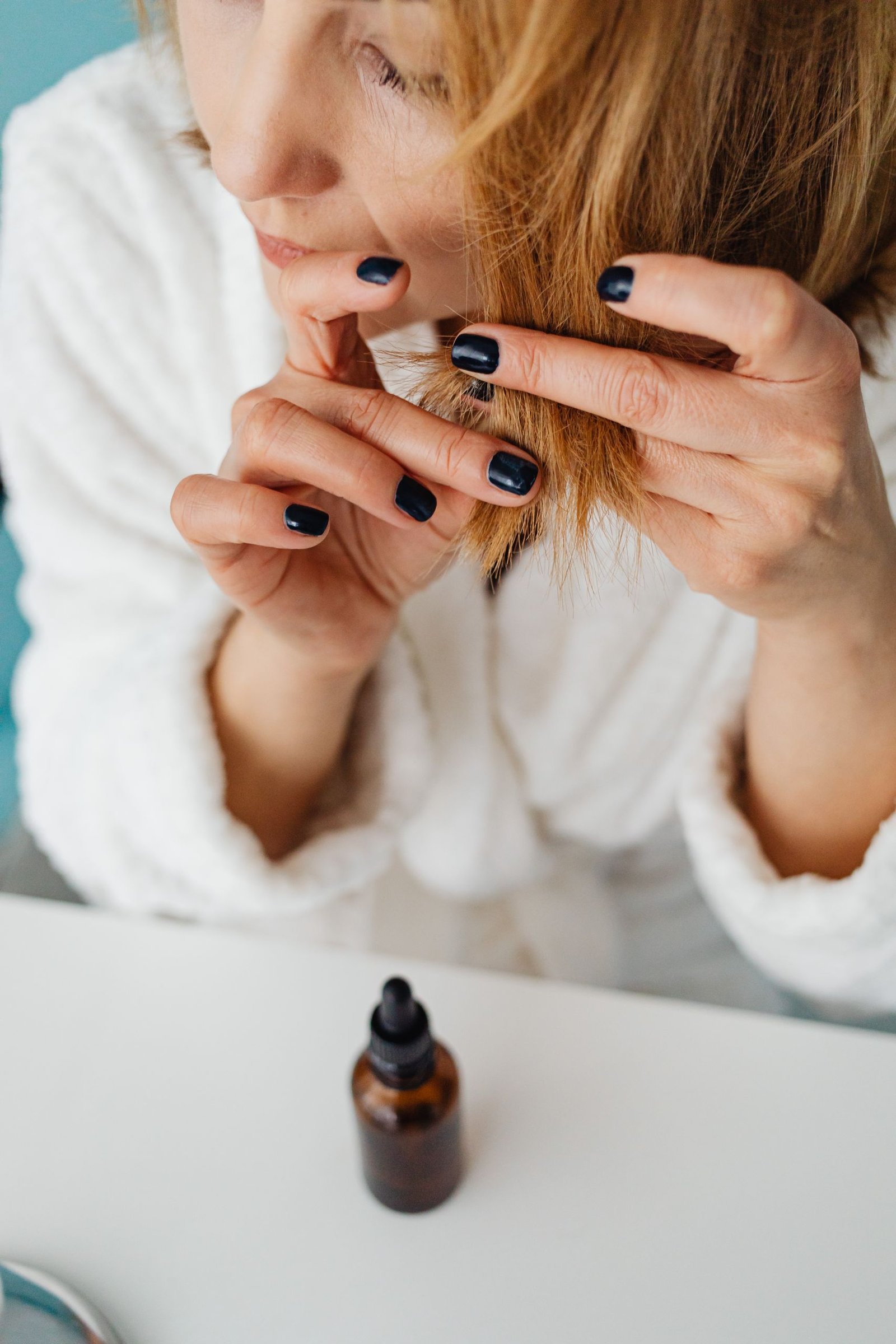
Porosity describes how easily your hair’s outer cuticle layer lets moisture in and out, and it has a bigger day-to-day impact on which products actually work than curl pattern alone. Hair with a tightly sealed cuticle behaves very differently from hair with a raised or damaged cuticle, even if both have the exact same curl pattern.
| Porosity Level | Cuticle Behavior | Common Signs | What Tends to Work |
|---|---|---|---|
| Low porosity | Tightly sealed, resists letting moisture in | Products sit on top of hair and take a long time to absorb, hair takes a long time to air dry | Lightweight, water-based products applied to damp hair; heat (like a warm towel) helps products absorb |
| Medium porosity | Slightly raised, absorbs and holds moisture reasonably well | Hair generally holds styles well and responds predictably to most products | A balanced routine without needing to correct heavily in either direction |
| High porosity | Very open or damaged, absorbs moisture quickly but loses it just as fast | Hair air dries quickly, tangles easily, and can feel dry again soon after moisturizing | Richer creams and butters, protein treatments, and sealing with an oil after moisturizing |
A simple way to get a rough read on porosity: take a few clean, freshly shed strands (not strands you pulled out) and drop them into a glass of room-temperature water. Hair that floats for several minutes before slowly sinking is typically medium porosity. Hair that sinks quickly usually indicates high porosity, since the open cuticle lets water in fast. Hair that stays floating on the surface for a long time usually indicates low porosity. This test is a helpful starting point, but it is not perfectly reliable on its own, since factors like product buildup or the oils naturally on the hair can skew the result. Paying attention to how your hair actually behaves with products over a few weeks is a more dependable long-term read.
Strand Texture: Fine, Medium, or Coarse
Texture is about the width of a single strand, not how much hair you have overall. To check yours, take one clean, dry strand and roll it between your fingers.
- Fine hair is difficult to feel or see individually and often has little grip when rolled between fingers. Fine hair is more prone to looking flat or greasy quickly, since oil coats it easily.
- Medium hair has a noticeable but not thick feel, and it is the most common texture.
- Coarse hair feels thick and has an obvious grip or texture when rolled between fingers, even though a single strand may be hard to see against a light background. Coarse hair typically needs more moisture and holds styles longer.
Texture and curl pattern are independent, so a person can have fine, straight hair or fine, tightly coiled hair, and the product weight that works for one will usually be wrong for the other. Fine hair of any curl pattern tends to get weighed down by heavy creams and butters, while coarse hair of any curl pattern usually needs those same richer products to avoid dryness and frizz.
Hair Density: How Much Hair You Actually Have
Density is a count of how many individual strands grow per square inch of scalp, and it is separate from both texture and curl pattern. A simple way to estimate your density is to gather a small, one-inch-wide section of hair at the crown, pull it into a low ponytail, and look at how much scalp shows through.
- Low density means you can see a good amount of scalp through the section, even when hair is dry and unstyled.
- Medium density means some scalp is visible but the section looks reasonably full.
- High density means very little to no scalp is visible, and the section feels thick and heavy.
Low-density hair, regardless of curl pattern, generally benefits from lighter products and volumizing techniques to avoid looking flat. High-density hair usually needs more product overall to reach every strand and may take longer to dry, style, and detangle.
Putting Your Full Profile Together
Once you know your curl pattern, porosity, texture, and density, you have a genuinely useful profile instead of a single label. The table below shows how these factors typically combine to shape a routine.
| Profile | Typical Challenge | General Approach |
|---|---|---|
| Fine, low porosity, straight to wavy | Products build up quickly and weigh hair down | Lightweight, water-based formulas applied sparingly, clarify regularly to prevent buildup |
| Coarse, high porosity, curly to coily | Hair dries out quickly despite frequent moisturizing | Rich leave-in conditioners, oils or butters to seal moisture in, occasional protein treatments |
| Medium texture, medium porosity, wavy to curly | Generally the most forgiving combination | A standard moisture-and-definition routine with room to experiment |
| Fine, high porosity, curly | Absorbs product fast but dries out just as fast, and can look limp under heavy products | Lightweight but frequent moisture, avoid heavy butters that weigh down fine strands |
If you specifically have a tighter, coily pattern in the 4A to 4C range, our complete guide to caring for 4A hair goes deeper into the moisture, detangling, and protective styling routine that tends to work best for that texture range. And once you understand your porosity and curl pattern, our explainer on whether curl-activating shampoos actually work covers how to choose a cleanser that matches your specific profile instead of guessing from marketing claims.
Common Mistakes When Identifying Hair Type
| Mistake | Why It Happens | Better Approach |
|---|---|---|
| Judging texture on wet or product-coated hair | Wet hair looks straighter and more uniform than it dries | Always evaluate on clean, fully dry, product-free hair |
| Forcing one label onto your whole head | Most heads have more than one curl pattern present | Note the range across your head and build the routine around your tightest section |
| Ignoring porosity entirely | Curl pattern is more visible and easier to identify at a glance | Test porosity separately since it affects product choice as much as curl pattern does |
| Assuming texture and density are the same | Both relate to “how much hair” someone appears to have | Texture is strand width, density is strand count; test each separately |
| Copying a routine from someone with the same type label | Curl pattern alone does not account for porosity, texture, or density differences | Use type as a starting point, then adjust based on your own porosity and texture |
Frequently Asked Questions
Can my hair type change over time?
Yes. Hormonal changes, pregnancy, aging, certain medications, and chemical processing like coloring or relaxing can all shift how your hair’s curl pattern looks and behaves. It is normal to reassess your type every so often rather than assuming it is fixed for life.
Is it possible to have more than one hair type?
Yes, and it is actually the norm rather than the exception. Many people have looser waves or curls at the crown and tighter patterns underneath or at the nape. Build your routine around your tightest section, since it usually needs the most moisture and gentlest handling.
Does hair type determine which products I should buy?
Curl pattern is a starting point, but porosity and texture usually matter more for actual product performance. Two people with the same curl pattern but different porosity levels often need very different formulas, so it is worth testing your porosity before assuming a product marketed for your “type” will work.
Why does my hair look different in humid weather?
Humidity adds moisture to the air, and hair (especially high-porosity or curly and coily hair) absorbs that extra moisture unevenly, which often shows up as frizz or a change in curl definition. Using an anti-humectant product or a stronger hold styler in humid conditions can help maintain your intended style.
Do I need different products for different hair types?
Not necessarily by curl pattern alone. What matters more is matching product weight and moisture level to your porosity and texture. A lightweight, water-based product suits fine or low-porosity hair of nearly any curl pattern, while a richer cream or butter suits coarse or high-porosity hair regardless of exactly how curly it is.
Final Thoughts
Curl pattern gets most of the attention, but it is really just one part of a bigger picture. Porosity, texture, and density each shape how your hair responds to products just as much as the shape of the curl itself, and understanding all four together is what actually leads to a routine that works. Once you know your full profile, choosing shampoos, conditioners, and stylers stops being guesswork and starts being a matter of matching the product to what your hair genuinely needs.