Top 10 Signs Of Carpet Beetles In Your Home
Carpet beetles are one of the more commonly misidentified household pests — people either mistake the damage for normal wear, or mistake the insect itself for a bed bug and worry about the wrong problem entirely. Neither natural fiber carpets, curtains, and wool clothing show damage until the infestation has been active for a while, so catching the early signs below matters more than with most household pests.
Quick answer: the clearest early signs are irregular holes in natural-fiber fabric, tiny hairy larvae or shed larval skins in dark, undisturbed spots, and small oval adult beetles near windows. Unlike bed bugs, carpet beetles don’t bite — any skin irritation comes from contact with the larvae’s bristly hairs, not a bite, which is one of the easiest ways to tell the two apart. If you’ve already confirmed that’s what you’re dealing with, skip ahead to our full carpet beetle treatment guide for the step-by-step removal process.
Carpet Beetles vs. Bed Bugs: Clearing Up the Confusion
This mix-up happens constantly, and it matters because the treatment for each is different. Bed bugs are flat, oval, roughly apple-seed-sized, move quickly when disturbed, and feed on blood — they bite. Carpet beetle larvae are fuzzy, bristly, worm-like, move slowly, and feed on natural fibers, not blood — they don’t bite at all, though their hairs can cause mild skin irritation in sensitive people who handle infested fabric directly.
10 Signs of Carpet Beetles
1. Irregular Holes in Natural-Fiber Fabric
Carpet beetle larvae feed on wool, silk, cotton, feathers, and fur specifically — they generally leave synthetic fibers alone. Holes that keep appearing in natural-fiber rugs, wool sweaters, or feathered cushions, especially near edges and seams, are one of the more reliable signs.
2. Shed Larval Skins
As larvae grow, they shed small, dry, slightly hairy brown skins that collect near where they’ve been feeding — under furniture, along baseboards, inside closets. These are easy to mistake for lint or dust at a glance, but they don’t disintegrate the way dust does when you touch them.
3. Small Adult Beetles Near Windows
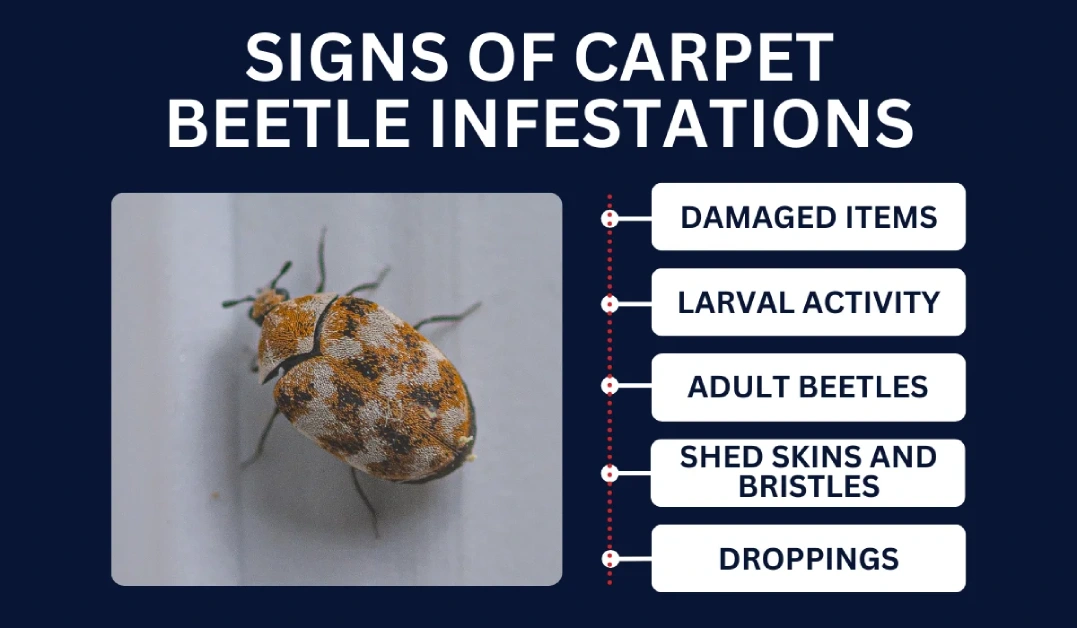
Adult carpet beetles are oval, a few millimeters long, and typically show a mottled black, brown, white, or orange pattern. They’re drawn to light and are commonly spotted on windowsills, even though the actual damage happens elsewhere from the larvae, not the adults congregating at the window.
4. Damage to Curtains and Upholstery
Beyond carpets, look at curtain folds, seams on upholstered furniture, and the underside of cushions — dark, undisturbed fabric folds are exactly where larvae prefer to feed without being disturbed by regular cleaning.
5. Larvae in Dark, Undisturbed Areas
The larvae themselves look like small, fuzzy, segmented worms, generally brown or tan. They avoid light and are most often found under furniture, inside closets, or in storage boxes that haven’t been opened in a while.
6. Fine Debris Along Carpet Edges
A gritty, uneven dust that keeps reappearing in the same spot even after vacuuming can be a mix of shed skins, waste, and broken-down fiber from active feeding underneath the carpet surface.
7. Damage in Long-Term Storage
Wool blankets, heirloom textiles, and out-of-season clothing stored for months are prime targets, since carpet beetles prefer calm, undisturbed conditions. Damage is often only discovered when the item is finally taken out.
8. A Faint Musty Smell Near Fabric
In a more established infestation, damaged fiber and insect waste can produce a mild musty smell concentrated around carpets, closets, or affected furniture — less common than the visual signs, but worth noting if it persists after normal cleaning.
9. More Activity in Warm Months
Reproduction speeds up in warmer weather, and consistently air-conditioned indoor spaces can keep conditions comfortable for them year-round rather than seasonally, which is why an infestation can persist quietly for months without a clear “season” to it.
10. Skin Irritation After Handling Infested Fabric
The bristly hairs on carpet beetle larvae can cause mild itching or a rash in sensitive people who handle infested items directly. This is contact irritation, not a bite — carpet beetles don’t bite people at all, which is a useful way to rule out bed bugs if you’re trying to identify what you’re dealing with.
What to Do If You Spot These Signs
- Identify and remove the source. Check the infested item(s) closely — an old wool rug, stored blanket, or dried floral arrangement (a surprisingly common source) — and isolate or discard it if the damage is extensive.
- Vacuum thoroughly and often, especially under furniture, along baseboards, and inside closets — this physically removes eggs, larvae, and shed skins, and is genuinely effective as a first response.
- Launder or dry-clean affected fabric on the hottest setting the material allows; heat kills eggs and larvae that vacuuming alone might miss.
- Steam clean carpets and upholstery where practical — see our carpet steam cleaning guide for the right process.
- Ready to treat an active infestation? Our complete carpet beetle removal guide walks through the full wash-freeze-vacuum-treat routine, including when an over-the-counter insecticide is actually worth using.
- Call a pest control professional if the infestation is widespread across multiple rooms or keeps returning after cleaning — at that point, larvae are likely established in places home cleaning can’t fully reach.
Frequently Asked Questions
Do carpet beetles bite humans?
No. Any skin irritation comes from contact with the larvae’s bristly hairs, not a bite — this is one of the clearest ways to distinguish a carpet beetle problem from bed bugs, which do bite.
How can I tell carpet beetles apart from bed bugs?
Bed bugs are flat, reddish-brown, roughly apple-seed sized, and move quickly. Carpet beetle larvae are fuzzy, worm-like, and move slowly; adult carpet beetles are smaller, oval, and mottled in color. Bed bugs feed on blood and bite; carpet beetles feed on natural fibers and don’t.
Can carpet beetles infest synthetic carpet?
Rarely as a food source — they strongly prefer natural fibers like wool, silk, and cotton. A synthetic carpet can still host larvae traveling through or hiding in it, but it’s not what they’re feeding on.
How long does it take to get rid of a carpet beetle infestation?
A minor, early-caught infestation can often resolve within a few weeks of thorough vacuuming, laundering, and removing the source item. A widespread or long-established infestation usually needs professional treatment and can take longer to fully clear. See our full treatment guide for the exact routine and timeline.
Final Thoughts
Carpet beetles cause slow, easy-to-miss damage, which is exactly why catching two or three of the signs above early is worth acting on rather than waiting to see if it gets worse. Remove and treat the source fabric, vacuum thoroughly and often, and call a professional if it’s spread across multiple rooms or keeps coming back after cleaning.