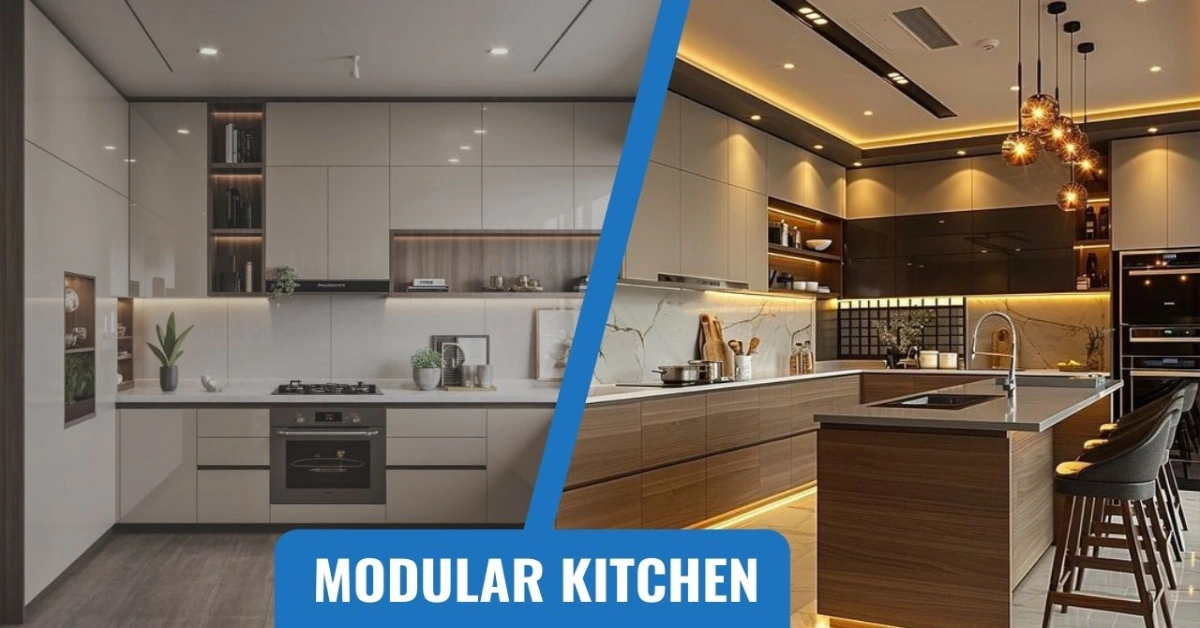
Top 20 Modular Kitchen Design Ideas for Dubai Homes
Quick answer: “Modular” means the kitchen is built from factory-made cabinet units (modules) in standard widths, assembled and finished on site — as opposed to a carpenter building custom carcasses from scratch. The material that matters most in the UAE is what the cabinet box (carcass) is made from, not the door finish: marine plywood resists humidity and AC-cycle condensation far better than standard MDF, which can swell near the sink and dishwasher within a couple of years. For layout ideas, see our full kitchen design and layout guide — this one focuses on what modular actually means, what it’s made of, and what it costs.
What “Modular” Actually Means
A modular kitchen is built from pre-manufactured cabinet boxes in standard width increments — commonly 30cm, 45cm, 60cm, and 90cm — that get combined and fitted to your specific kitchen footprint, then finished with your chosen door style, countertop, and hardware. This is different from a fully custom, carpenter-built kitchen made from scratch to non-standard dimensions.
The practical upside: modular systems are faster to install, generally more consistent in quality (factory-cut vs. site-cut), and easier to reconfigure or replace a single unit later. The trade-off: very unusual room shapes or specific storage requests sometimes fit a fully custom build better than modular units forced into odd dimensions.
Carcass Material: The Decision That Actually Matters Most
Most buyers focus on door color and countertop stone first. The material choice that actually determines how long the kitchen lasts is the cabinet box itself:
| Carcass Material | Moisture Performance | Relative Cost |
|---|---|---|
| Standard chipboard/particleboard | Poor — swells fastest near sink/dishwasher | Baseline (lowest) |
| Moisture-resistant (E1) chipboard | Improved, still not ideal near constant water exposure | +10–15% |
| MR-MDF (moisture-resistant MDF) | Better than standard MDF, but layered plywood still outperforms it in humidity | +20–30% |
| Marine plywood | Best — layered construction resists swelling from UAE humidity and AC-cycle condensation | +35–50% |
| Solid hardwood | Very good, but rarely used for the hidden carcass given the cost premium | +80–120% |
Marine plywood is what most premium UAE contractors specify for kitchen carcasses specifically because of the combination of high humidity and constant AC cycling — standard MDF is the material most likely to swell and delaminate near the sink within a couple of years. If a quote doesn’t specify carcass material, ask directly — it’s easy for a lower quote to hide a cheaper, less durable box behind an attractive door finish.
Door Finish Costs (Per Door, AED)
| Finish | Price Range (AED/door) |
|---|---|
| Melamine-faced MDF | 180–280 |
| PVC membrane | 220–350 |
| High-gloss lacquer | 320–480 |
| Matt lacquer | 340–500 |
| Acrylic high-gloss | 400–600 |
| Natural wood veneer | 480–750 |
| Aluminium frame with glass | 550–900 |
Countertop Costs (Per Linear Metre, AED)
| Material | Price Range (AED/lm) |
|---|---|
| Laminate | 180–280 |
| Compact laminate | 350–550 |
| Granite | 500–900 |
| Quartz | 650–1,100 |
Layout Types Available as Modular Systems
- Straight-line: All cabinets and appliances along one wall — most space-efficient for small kitchens.
- L-shaped: Two adjoining walls, freeing a corner for a table or extra floor space.
- U-shaped / parallel (galley): Maximum counter and storage for larger kitchens, or two facing counters for narrow ones.
- Island: Adds a modular island unit as a fourth workstation — only worth it if the room has enough clearance on all sides (see our layout and clearance guide for the actual minimum widths).
Smart Storage Worth Actually Paying For
- Corner carousels reclaim otherwise-dead corner cabinet space — genuinely useful, not just a showroom gimmick, in L- and U-shaped layouts.
- Pull-out pantry units hold more per square foot of floor than a standard shelf cabinet and keep items visible rather than buried behind each other.
- Vertical tall units (floor to near-ceiling) are simply more cubic storage for the same footprint — worth prioritizing over decorative open shelving in a smaller kitchen.
Frequently Asked Questions
What’s the difference between a modular kitchen and a custom-built one?
A modular kitchen uses factory-made cabinet units in standard width increments, assembled on site and finished to your specifications — faster and generally more cost-effective. A fully custom kitchen is built from scratch to exact, often non-standard dimensions — better suited to unusual room shapes, at a higher cost and longer lead time.
What material should the cabinet carcass be in the UAE specifically?
Marine plywood is the material most premium UAE contractors specify for kitchen carcasses, because its layered construction resists the swelling that standard MDF or particleboard experience from humidity and constant AC-cycle condensation — especially in the cabinets nearest the sink and dishwasher.
How much does a modular kitchen actually cost in the UAE?
Cost depends on carcass material, door finish, countertop choice, and kitchen size — expect standard chipboard with laminate doors and countertops at the budget end, and marine plywood carcasses with acrylic or veneer doors and quartz countertops at the premium end. Door finishes alone range from roughly AED 180 to 900 per door depending on material, and countertops from AED 180 to 1,100 per linear metre.
Are glass-front cabinets a good idea for a modular kitchen?
They work well for display pieces (nice dishware, glassware) in a kitchen that’s kept generally tidy, since everything behind the glass is visible at all times. They’re a poor fit for cabinets used for everyday, mismatched storage — the visibility that makes them attractive for display becomes a downside for general clutter.
Editorial note: Material and cost figures reflect current UAE kitchen cabinetry and carpentry market data as of 2026 and vary by supplier, kitchen size, and finish tier. Always request the specific carcass material in writing on any quote — it’s the detail most often left vague.